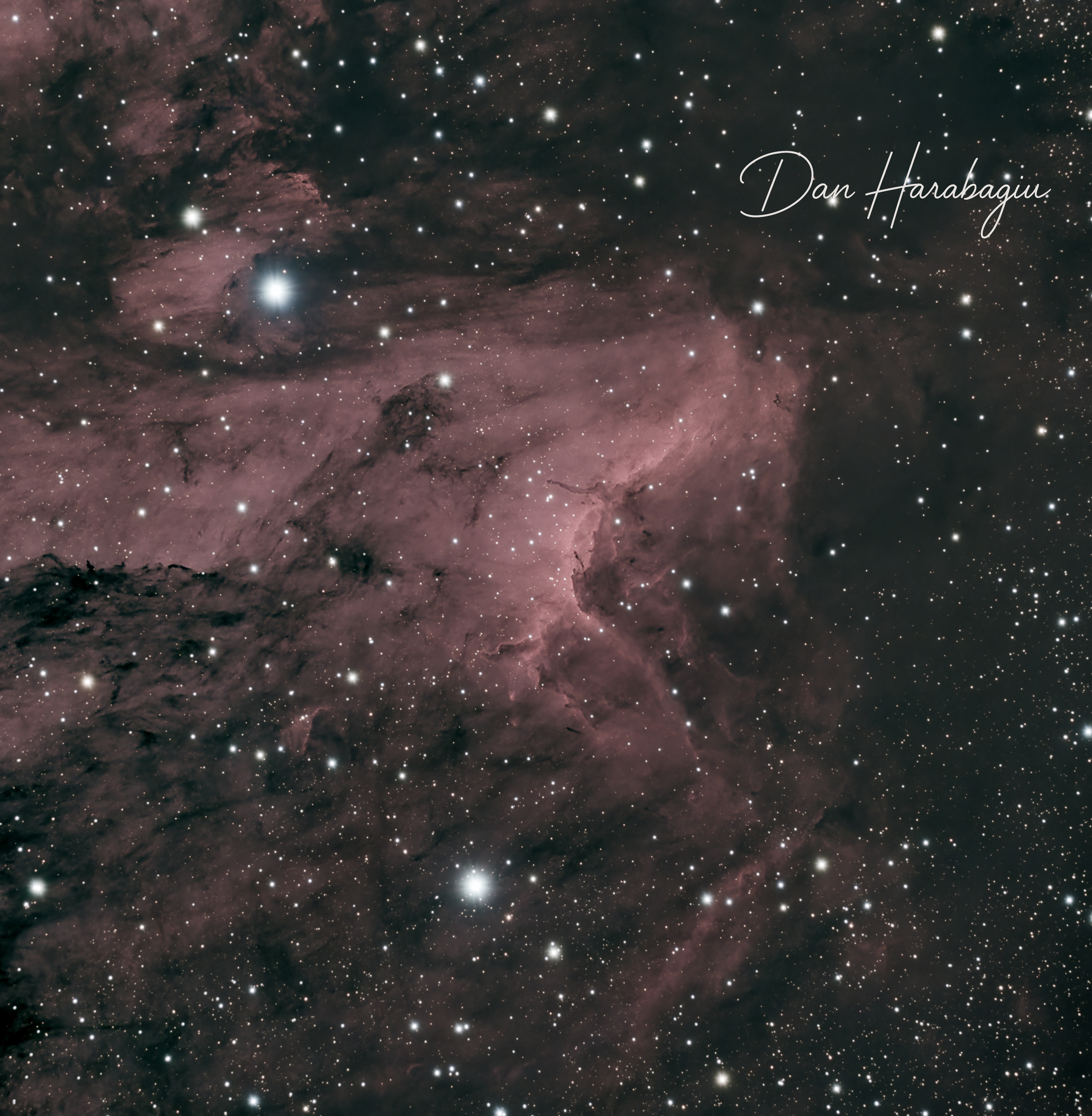
 A detailed view of IC 5070, the Pelican Nebula, in the constellation Cygnus.
Overview
- Name: Pelican Nebula
- Catalog: IC 5070
- Constellation: Cygnus
- Distance from Earth: ~1,800 light-years
- Apparent Size: ~60 arcminutes
- Type: Emission nebula / H II region
What We See
This image captures IC 5070, commonly known as the Pelican Nebula, a large emission region shaped by radiation from nearby young stars. Its outline resembles the profile of a pelican, with bright hydrogen clouds, dark dust lanes, and sculpted ridges spread across the field.
Visible in long-exposure imaging are:
- Bright hydrogen-alpha emission tracing energized interstellar gas
- Dark molecular dust clouds that block background light
- Complex edges and pillars shaped by stellar winds and ultraviolet radiation
Scientific Significance
- IC 5070 is part of the broader North America and Pelican Nebula complex in Cygnus
- It is an active star-forming region, where dense gas and dust continue to collapse into new stars
- The nebula’s detailed structure reveals how radiation from massive stars reshapes surrounding interstellar material
Equipment Used
- Telescope: TS-Optics 80PHQ (544mm f/6.8 Quintuplet APO)
- Camera: SVBONY SV605MC (IMX533 Mono)
- Mount: Sky-Watcher EQ5 Pro
- Guiding: Off-Axis Guider with veLOX 178 C
- Filters: LRGB / Hα
- Software: NINA, PHD2, PixInsight, Photoshop
- Acquisition: 20 x LRGB (120s), 40 x Hα II (300s)
- Exposure Time: Long integration for faint nebulosity and structural detail
Final Thoughts
IC 5070 is a rewarding deep-sky target, rich in glowing gas, dark dust, and subtle structure. Its proximity to the North America Nebula makes it part of one of the most recognizable and photogenic emission complexes in the northern sky.
A celestial shoreline of gas and dust, shaped by light across thousands of years.
Clear skies!